Why Polished Silver Looks Different Across Its Surface
Learn how polished silver’s surface finish and shape alter its visual character, so you can describe and compare silver without relying on shine alone.
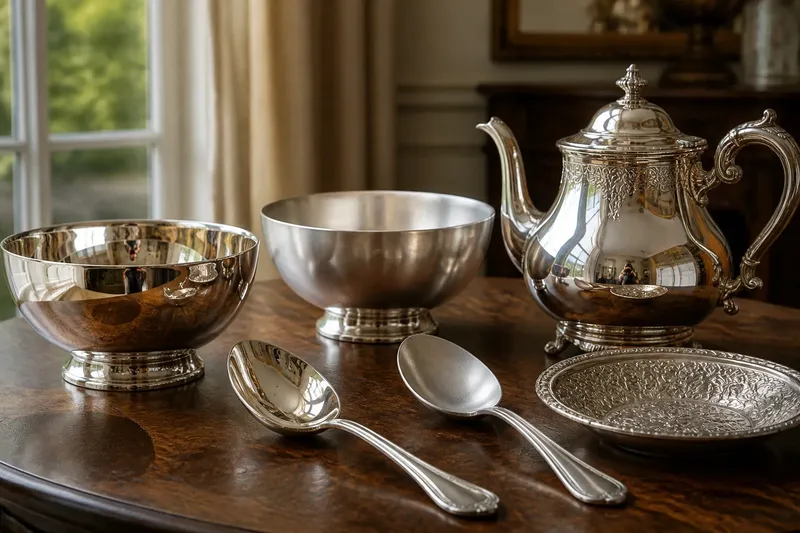
Why does one polished silver bowl show crisp lines while another looks like a soft blur? The difference often comes from surface finish and form: polish can preserve recognizable details, while curves and fine surface texture alter their appearance. To compare polished silver, look at the character of the reflected image, not just its brightness.
Polished silver reveals details differently from softer finishes
A smooth, highly polished surface can show recognizable outlines. A satin finish scatters the image into a softer glow, while a matte surface tends to make reflected details less distinct. These labels describe appearance, but they do not tell the whole story of an individual object.
Run your eyes across the piece rather than treating the surface as uniform. A silver teapot may have a bright, smooth body, a softened handle, and engraved areas that interrupt the reflection. Changes in finish can make one object look visually varied without changing its material.
Separate three observations: how bright the surface appears, how clearly it shows recognizable forms, and how evenly the finish looks across the object. That vocabulary helps you describe what you see without treating brightness as a measure of quality.
Shape bends reflected forms and changes their apparent clarity
Silver’s form affects its visual appearance as much as its finish. A curved bowl can stretch or bend a straight line, while a flatter panel may preserve a more recognizable outline. A rim, ridge, or engraved detail can break up an otherwise continuous surface.
Compare similar areas when you can. Looking at the broad side of one object and the narrow neck of another may tell you more about their different shapes than about their finishes.
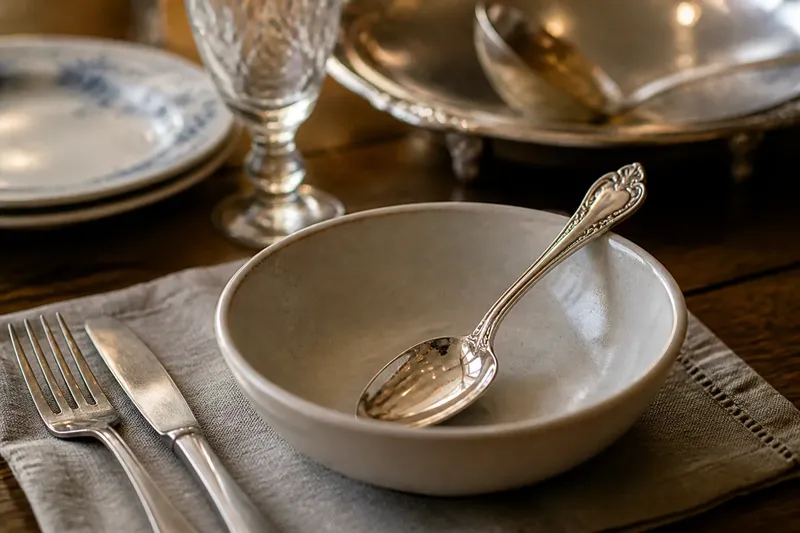
Say you are comparing two silver spoons: one has a polished, rounded bowl and the other a satin-finished, flatter bowl. If the first shows a curved, crisp outline and the second a softer, less distinct image, record both the finish and the shape; neither observation alone explains the full difference.
Describe a silver finish with specific observations
Use concrete words rather than a single judgment such as “shiny.” You can note whether lines appear crisp or softened, whether bright areas are concentrated or spread out, and whether the surface looks consistent or changes near decoration.
- Check the broadest plain area. If its surface shows crisp outlines, describe the finish as reflective; if outlines look softened, describe it as diffuse and compare another plain area before deciding whether the finish is consistent.
- Check for a satin-like appearance. If the surface has a soft, even glow, describe it as satin-like; if it instead shows distinct outlines, describe the reflection as clearer rather than relying on the finish label.
- Check engraved or chased details. If the decoration breaks up the image, note that separately; if it does not, describe the surrounding surface and ornament as visually continuous.
- Check curves and edges. If outlines bend or stretch near a curve, attribute that effect to form; if they remain comparatively straight on a flatter panel, describe the panel separately.
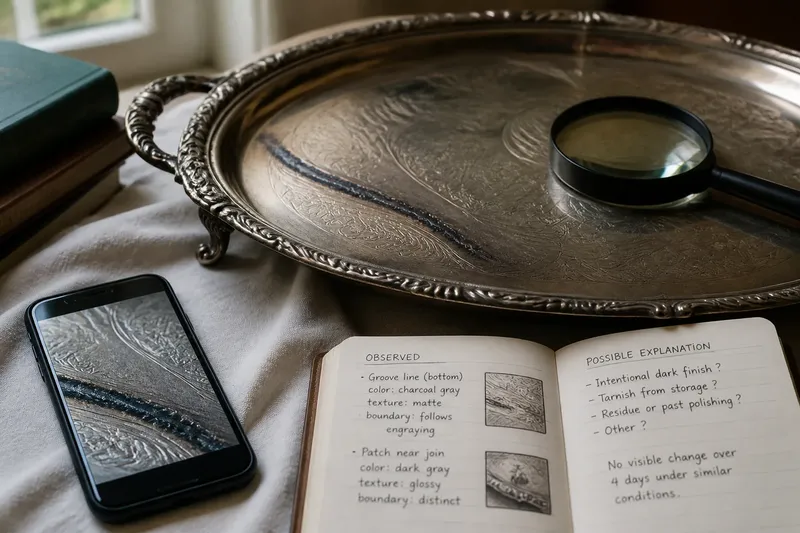
- Check for uneven appearance across the object. If one area looks smoother or duller than another, record the location; if the finish appears consistent, describe it as even across the areas you examined.
- Check any maker or seller description. If a label names a finish, preserve that wording while noting what you observe; if no description is available, use a plain visual description rather than guessing how the object was made.
These checks help keep visual description separate from assumptions about manufacture or condition.
Which details help distinguish silver finishes?
Does polished silver always show a clear image?
No. A polished surface can show recognizable forms, but curves, small surface irregularities, decoration, and the viewing conditions may soften or distort them. Describe the visible effect on the particular area rather than assuming every polished object looks mirror-like.
What does a satin finish look like?
A satin finish often appears softer and less mirror-like than a highly polished one. Use the term cautiously if you do not know the maker’s description, and distinguish what you observe from what a label says.
How can I tell whether shape or finish affects the appearance?
Compare similar areas, such as the broad sides of two pieces, and note whether their shapes differ. If one surface is curved and the other flatter, describe the distortion as a form effect before drawing conclusions about finish.
What should I write when the finish is unclear?
Describe the visible qualities: “soft glow,” “crisp outlines,” or “uneven appearance near the engraving.” If the object has a maker’s label or reliable product description, use it as supporting information rather than replacing direct observation.
Keep finish descriptions separate from care decisions
A dull-looking area does not, by itself, tell you why it looks that way. Finish, surface condition, decoration, and the object’s construction can all affect appearance. Avoid polishing an unfamiliar or decorated piece merely to make it brighter, since cleaning can alter a surface or remove material.
If the object is valuable, antique, plated, or has a fragile finish, ask a qualified silver conservator or reputable specialist before cleaning it. For an ordinary household item, follow the maker’s care instructions when available and use a method suitable for its material and decoration.
For polished silver, a useful description names the finish, the form, and the visible effect together. “Polished body with softened outlines around the engraved band” gives a reader more to work with than “very shiny,” and it remains accurate even when the object is seen in a different setting.