What Silver Patina Can—and Cannot—Tell You
Use silver patina observations to distinguish visible darkening from assumptions, record changes safely, and decide when a conservator should assess the surface.
Does silver patina tell you why a surface darkened? Not by itself. Silver patina is the visible change you can describe; identifying whether it is tarnish, an intentional finish, residue, or something else may require a closer assessment.
To focus your observation, track the darkened areas rather than trying to interpret the object’s overall history. Leave the surface untouched while you document it, because polishing, rubbing, or dipping can change the very details you want to examine.
Record the patina’s color, texture, and boundaries
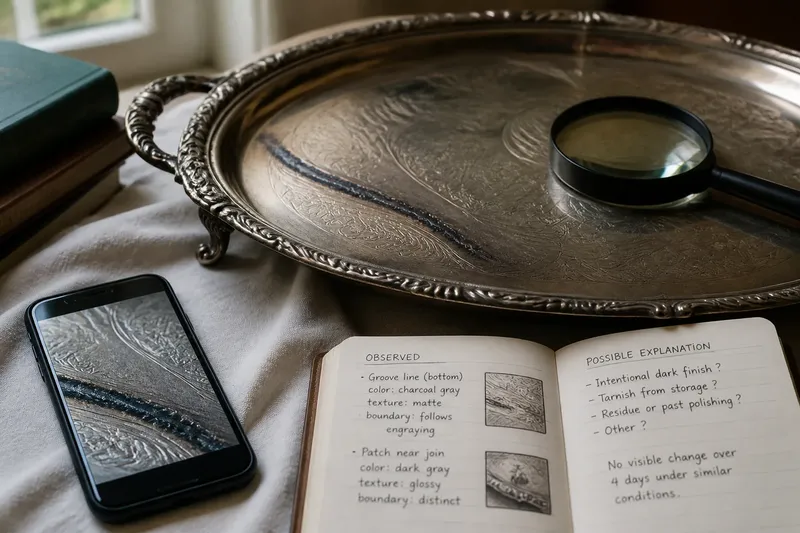
Set the object on a clean, soft cloth in steady, indirect daylight. Photograph the same darkened area from the same angle, then describe what is visible: its color, whether it looks matte or glossy, and whether its boundary is sharp, feathered, or broken.
Use a phone camera and, if available, a magnifier. Do not scrape or rub a patch to see what lies beneath. A useful note is “blue-gray shading along the bottom of the engraved groove,” not “wear from years of use.”
Keep a simple record of the surface itself: location, color, texture, and any visible boundary. Set aside explanations until you have supporting evidence.
Compare darkened patches without disturbing them
Look at two or more darkened areas under the same light. Note whether their colors and textures match, whether each follows a recessed line, and whether a boundary stops at a raised edge or crosses it. These comparisons describe the patina’s distribution; they do not identify its cause.
Check the object’s joins and engraved details visually, without probing them. If the darkening appears only in recesses, record that pattern. It may be useful to a conservator, but it does not establish whether the finish is intentional or developed over time.
Watch for change under stable conditions
Leave the object in a dry, ordinary indoor place away from direct sunlight, cooking fumes, and damp areas. Once a day, view it under similar light and note whether a particular patch looks different. A change in lighting can alter apparent color, so compare photographs made from the same position before deciding that the surface itself changed.
If a patch seems to change, record exactly what looks different: its edge, color, or sheen. Do not clean it to check. If no visible change occurs, record that too; stability does not explain how the patina formed.
Imagine you have a silver-colored tray with a charcoal-gray line in one engraved groove and a second dark patch near a join. On the first day, you photograph both in indirect daylight and note that the groove line is matte while the patch is glossy. Over the next few days, using the same position and light, you see no clear change; you record that result and keep the tray untouched. Your answer is that the two areas differ in appearance and remained visually stable during observation—not that either one is old tarnish or evidence of a particular use.
Separate what you see from what you suspect
Review your notes and divide them into “observed” and “possible explanation.” “Dark gray, matte, inside the groove” belongs in the first column. “Intentional dark finish” or “tarnish from storage” belongs in the second until another source supports it.
Silver alloy, applied finishes, storage, contact with other materials, previous cleaning, and lighting can all complicate interpretation. A dark appearance alone cannot distinguish among tarnish, an intentional finish, residue, wear, or another surface condition.
What should you do with silver patina?
Does dark silver mean an object is old?
No. Darkening describes a surface condition, not a dependable age label. An object may have been cleaned or refinished, and similar darkening can occur on objects with different histories.
Can patina show whether a dark finish was intentional?
Appearance alone may not settle that question. Record where the dark areas sit and how their edges and textures look, then ask a qualified conservator or silver specialist if the distinction matters.
Should you polish a patch to identify it?
No, not when the finish or significance is uncertain. Polishing, rubbing, and silver dips can remove or alter surface material, so seek qualified advice before changing the area.
When is a professional assessment useful?
Consult a qualified conservator or reputable silver specialist if you need to identify the finish, assess an object’s history, or decide how to care for a piece with uncertain materials. Share your photographs and descriptions, and avoid cleaning the surface before the assessment.
Use a surface checklist before taking action
Check each detail and let the result guide your next move. If a finding is uncertain, choose the less altering option and ask a qualified professional when the object’s finish or significance matters.
- Check whether the photograph uses steady, indirect light; if it does, compare it with another image made from the same position, and if it does not, retake it before judging a color change.
- Check whether the dark patch has a visible edge; if the edge is clear, record where it stops, and if it is indistinct, describe it as diffuse rather than assigning a cause.
- Check whether the patch looks matte, glossy, or powdery without touching it; if its texture is uncertain, note that uncertainty and do not rub it to find out.
- Check whether darkening follows a groove or crosses a raised area; if it follows the groove, map that location, and if it crosses the raised area, photograph the boundary for professional review if needed.
- Check whether the same patch appears different in comparable photographs; if a visible change remains under similar lighting, stop handling the object and seek qualified advice, and if not, record that no change was apparent.
- Check whether the object’s finish or composition is known; if either is uncertain, avoid dips and abrasive cloths, and if maker guidance is available, consult it before routine care.
- Check whether your note states an observation or an explanation; if it states an explanation, move it to a separate “possible” column, and if it states a visible detail, keep it in the observation record.
Keep the photographs and notes together, especially if someone else will assess the piece. Silver patina is easiest to discuss when the record preserves what you saw without turning a color or texture into a claim about age.