A Pendant or a Brooch: Two Different Ways to Place Silver
Choose a silver pendant or brooch by matching its placement to your neckline, fabric, and movement, so the piece supports the look you intend.
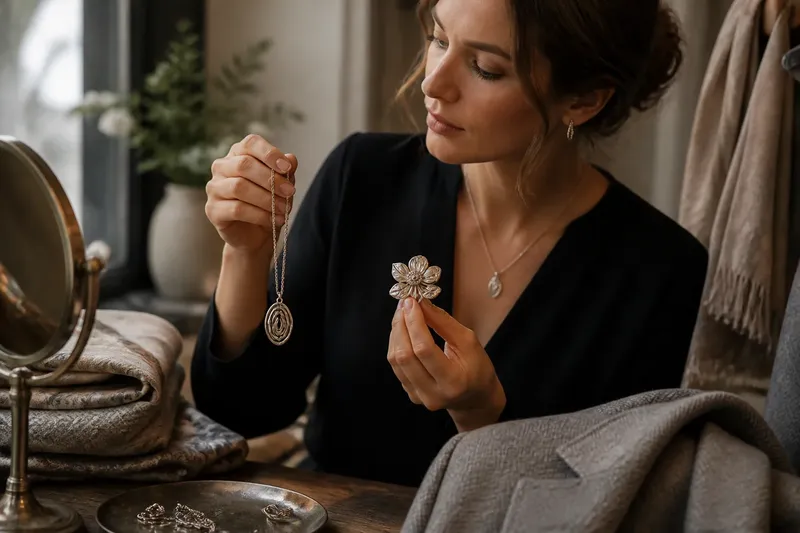
Should silver sit in the moving space below your face, or stay fixed on the fabric you choose? A silver pendant or brooch makes a different claim: one follows the body’s motion, while the other marks a point on clothing. Start with where you want the eye to pause, then consider the garment and the way you move in it.
1. Let the intended focal point choose the form
A pendant draws attention along the center line of the torso. Its chain creates a route from the neck toward the chest, and the silver element at its end becomes the visual destination. This can suit an open neckline, a simple shirt, or a dress whose front has room for a small point of emphasis.
A brooch makes a more localized mark. It can anchor attention at a lapel, shoulder, collar, or scarf fold without drawing a line down the body. Choose it when the garment already has a clear shape you want to underline, or when you prefer an accent off center.
Say you are choosing jewelry for a plain crew-neck top. A pendant that sits just below the neckline would create a center point, while a brooch near one shoulder would shift the emphasis outward. The expected visible difference is where the eye lands first, not which piece is inherently more formal.
2. Match a pendant to the neckline and its open space
A pendant needs room for both chain and silver form. A high neckline can leave only a short section of chain visible; a low or open neckline may provide a longer visual path. Neither arrangement is automatically better, but the pendant should have enough clear space to read as an intentional detail rather than a crowded one.
Check where the chain meets the garment and where the pendant rests when you stand naturally. A chain that disappears under a collar or crosses a busy pattern may make the silver element harder to see. Try the piece with the actual top or dress, not only with a bare neckline.
Consider the pendant’s shape alongside the neckline’s shape. A narrow vertical form can reinforce a V-shaped opening, while a rounded form may soften the edge of a collar. These are visual possibilities, not rules: the garment’s pattern, the chain’s length, and the pendant’s scale all affect the result.
3. Place a brooch where the fabric can support it
A brooch works directly through the garment, so fabric matters. Woven jackets, coats, and sturdy scarves may offer a more stable place for a pin than thin knits or delicate cloth. A heavy piece on a light fabric can pull the material down or leave it visibly distorted.
Look at the back of the garment as well as the front. A lining, seam, or reinforced edge may provide a more secure and discreet place for the fastening, while a loose or layered section may let the brooch tilt. Avoid piercing fabric that is precious or difficult to repair unless you are comfortable with the possibility of a mark.
Position affects the whole silhouette. A brooch close to the shoulder can frame the face; one at a lapel can clarify the jacket’s edge; one on a scarf can hold attention at the knot or fold. Pin it where the cloth lies naturally, rather than forcing a fold just to create a display point.
4. Think about movement before choosing a placement
A pendant moves with the chain and the body. Walking, bending, and turning can make it swing or shift, which may add a lively quality to an outfit. If that motion would distract you, or if the pendant catches against a collar, try a shorter chain or a different neckline before deciding it is the wrong form.
A brooch stays attached to one area of clothing, but the fabric around it can move. A scarf may flutter, and a soft jacket may flex, so a pinned piece can still change its angle. A brooch on a firm lapel is likely to read as more settled than one on a loose, moving layer.
Think through the ordinary motions of the occasion: reaching for a bag, sitting at a desk, or putting on a coat. The useful question is not whether the jewelry moves at all, but whether its movement supports the look and remains comfortable in the clothes you plan to wear.
5. Use scale and visual weight to keep the outfit balanced
A pendant’s visual weight gathers at the end of its chain. A small silver form can provide a quiet center point, while a broad or strongly shaped pendant can carry more attention. If the neckline already has ruffles, a tie, or a prominent collar, a simpler pendant may leave the details legible.
A brooch concentrates its visual weight at one spot on the garment. That makes it useful for balancing an asymmetrical neckline or adding definition to a plain lapel, but a large piece can dominate a delicate fabric or a crowded pattern. Look at the whole outfit in a mirror from a few steps away; close-up inspection can make a small detail seem more prominent than it appears at normal viewing distance.
Silver’s color also interacts with the clothing around it. Against a dark, plain surface, an outline or textured form may stand out clearly; against a pale or patterned surface, the piece may read through its shape and placement instead. Choose the form that gives the silver a clear role without asking it to compete with every other detail.
6. Choose the fastening and wearing habit you will actually use
A pendant is straightforward to put on when its chain and clasp are easy for you to handle. Check that the clasp closes comfortably and that the chain sits as intended with the garment. If you layer necklaces, consider whether their chains tangle or obscure the pendant’s position.
A brooch asks for a deliberate pinning point and a garment that can take the fastening. Its appeal may be the ability to reposition it across suitable jackets, scarves, or other clothing, but the pin should close securely and sit flat. Follow the maker’s care and wearing guidance, especially for a piece with a particular backing or construction.
Where the right choice depends on the jewelry’s fastening, garment label, or care instructions, follow those directions rather than relying on a general rule. Keep a small cloth for handling silver if you want to avoid fingerprints while moving a piece between outfits.
Which silver form fits the look you want?
Can a brooch be worn on a scarf?
Yes, if the scarf’s fabric can support the pin without snagging or pulling. Place it through a stable fold and check that the fastening is closed before wearing the scarf.
Does a pendant work with a high neckline?
It can, though the visible chain may be short or partly hidden. Try the pendant against the actual neckline and choose a form that remains clear in the space available.
Which form is better for an asymmetrical outfit?
A brooch can reinforce an off-center line, while a pendant can introduce a contrasting center point. Decide whether you want to echo the garment’s asymmetry or balance it.
Can the same silver piece serve both purposes?
Some pieces are designed with fittings that allow more than one way to wear them. Check the construction and instructions before changing how it is attached; a pendant should not be improvised as a brooch, or the reverse.
Choose the placement that makes the outfit feel deliberate
For a silver pendant or brooch, make the decision by pairing the piece with the garment and checking its focal point, fabric, and movement. Pick a pendant when a line toward the center of the body suits the neckline; choose a brooch when a fixed accent better defines a lapel, shoulder, or fold. Before leaving, look at the piece in the mirror while standing and sitting so its placement still makes sense in motion.